There is a particular kind of exhaustion where your body is clearly finished for the day but your head refuses to agree. You lie down, and instead of drifting off you start rehearsing a conversation from four hours ago, or drafting an email you will not send until Tuesday.
That is not really a sleep problem. It is a transition problem. Your nervous system has been in a mildly alert state since roughly seven in the morning, and nothing so far has told it the day is over.
What follows is seven ways to send that message, each with a note on how strong the evidence actually is. That last part matters more than it sounds, because a lot of wind-down advice circulates as settled fact when the underlying research is genuinely mixed. We have flagged those cases rather than quietly repeating them.
We also cover the part most articles skip: what to do when you know all of this and still do not do it. That is where a device such as Pulsetto changes the equation, and we come back to it at the end with the specifics.
The short version
- Best evidence, least effort: moving your caffeine cut-off earlier and taking a warm bath about 90 minutes before bed.
- Solid but oversold: slow breathing works; the specific "longer exhale" rule is on shakier ground than you have been told.
- Underrated: writing tomorrow's list down, because the loop is usually your brain refusing to trust you to remember.
- The real bottleneck: not knowledge. You already know most of this. Doing it nightly when you are tired is the hard part, which is why a four-minute device session like Pulsetto's sleep programme changes the odds.
Why your nervous system does not simply switch off
Your autonomic nervous system runs in the background without your input, and it has two broad settings. The sympathetic side is the accelerator: heart rate up, breathing shallow and quick, digestion paused. The parasympathetic side is the brake: heart rate settling, breathing deepening, the body shifting into repair.
The vagus nerve is the main pathway of that second system, which is why it turns up in every conversation about calming down. We cover what it is and where it runs in our plain-English guide to the vagus nerve.
The useful framing is this: the goal is not to shut the accelerator off permanently. It is to be able to come back down after using it. Everything below is a way of nudging that shift along.
The seven methods at a glance
Before the detail, here is the honest summary. Evidence strength refers to how well supported the specific claim is, not to how much you personally will benefit.
| Method | Evidence | Effort | Cost | Timing |
|---|---|---|---|---|
| Earlier caffeine cut-off | Strong | Low, but unpopular | Free | 8–12 h before bed |
| Warm bath or shower | Strong | Low | Free | ~90 min before bed |
| Slow breathing | Strong for slow pace Mixed for exhale ratio |
Low | Free | Any time, incl. in bed |
| Cutting evening alcohol | Strong | Low, but unpopular | Free | Evening |
| Dimming light early | Moderate | Low | Free | 60 min before bed |
| Writing the list down | Moderate | Very low | Free | 30–60 min before |
| Gentle movement | Modest | Medium | Free | Evening, not late |
Notice the pattern. Every method here works, and every one of them depends entirely on you executing it at the end of a long day. That is the gap the last section deals with, and it is the reason most people who fix their evenings end up building the routine around something that runs itself.
1. Move your caffeine cut-off earlier
Caffeine has a half-life of roughly three to six hours, but individual range runs from 1.5 to 9.5 hours. Trial evidence suggests around 100 mg is tolerable four hours before bed, while 400 mg can disrupt sleep architecture even twelve hours ahead.
This goes first because it has the best evidence-to-effort ratio on the list, and because it is the one most people skip in favour of something more interesting.
Half-life is the useful concept. If you drink a coffee at 4pm and your personal half-life is five hours, roughly half of that caffeine is still circulating at 9pm and a quarter at 2am. You may not feel wired. Sleep depth is affected regardless of whether you notice.
A randomised crossover trial published in SLEEP found that 400 mg consumed within twelve hours of bedtime produced significant delays in falling asleep and changes to sleep architecture, with greater fragmentation when taken within eight hours [4]. An earlier and often cited study found 400 mg taken six hours before bed reduced measured sleep by more than an hour [5].
What 400 mg actually looks like
- Roughly four cups of home-brewed coffee
- Or about two large takeaway coffees, depending on the chain
- Or two energy drinks plus a coffee
That is a normal day for a lot of people, not an extreme case. If your evenings are difficult and you drink coffee after lunch, this is the single biggest lever available to you, and it costs nothing.
It also clears the ground for the next step to actually work. Cutting caffeine removes the chemical reason you are still wired, but it does not give your evening a clear "day is over" signal. That is the specific gap a short Pulsetto session before bed is built to close, once the caffeine itself is out of the way.
"Caffeine does not affect me"
Genuine variation in caffeine metabolism is large, so this is not always wrong. But the studies above measured sleep architecture rather than asking people how they slept, and disruption showed up in people who reported feeling fine. Not noticing and not being affected are different things.
2. Take a warm bath about 90 minutes before bed
A meta-analysis of seventeen studies found warm bathing at roughly 40 to 42.5 degrees Celsius, one to two hours before bed, shortened the time taken to fall asleep by about 36 percent. Around 90 minutes before bedtime appears to be the practical sweet spot.
This one sounds backwards. Warming up to cool down? But the mechanism is well described: warm water pulls blood toward the surface of your hands and feet, which increases heat loss afterwards and accelerates the natural drop in core temperature that accompanies falling asleep [3].
The reason so many people report it not working is timing. A hot shower five minutes before bed leaves you warm at exactly the wrong moment. The gap is the entire point.
The practical version
- Temperature: comfortably hot, around 40 to 42.5 °C. Not scalding.
- Duration: as little as ten minutes appears sufficient in the pooled data.
- Timing: aim for 90 minutes before you intend to sleep. One to two hours is the effective window.
- Shower works too. The meta-analysis covered both showers and baths.
A cooler bedroom supports the same mechanism from the other direction, which is why the advice to keep the room slightly cold keeps reappearing.
3. Slow breathing, with an honest caveat
Slow breathing itself has solid evidence for increasing parasympathetic activity. The specific claim that a longer exhale beats an even ratio is weaker than commonly stated. One review found nine studies reached four different conclusions, so treat exact ratios as optional rather than essential.
Here is where we part company with most articles on this subject.
The well-supported part: a systematic review and meta-analysis of voluntary slow breathing found it increases parasympathetic control of the heart, reflected in higher heart rate variability measures [1]. Breathing slowly, somewhere in the region of five or six breaths a minute, does something real.
The oversold part: the near-universal instruction to make your exhale longer than your inhale, often as a strict 4-7-8 or 1:2 ratio. A 2024 review in Applied Psychophysiology and Biofeedback examined studies comparing different inhale-to-exhale ratios and found nine studies producing four different conclusions, with no definitive answer on which ratio best raises HRV [2].
Why this matters practically
If you have tried 4-7-8 breathing, found the counting stressful, and concluded that breathing techniques are not for you, the research suggests the counting was never the important part. Slowing down was. Drop the ratio, keep the pace, and see whether that is easier to sustain.
A version that survives being tired
- Breathe in through your nose, unhurried, for about four counts.
- Breathe out through your mouth, also unhurried, for four to six counts. If six feels like straining, use four.
- Repeat eight to ten times. Two minutes total.
- If you lose count, start again without treating it as a failure. There is no score.
The effect is cumulative and modest rather than instant and dramatic. Most people who try it once and feel nothing have simply not given it a week.
If counting breaths is the part that makes people quit, it is worth knowing that this is the same physiological lever vagus nerve devices are built around: cervical stimulation, delivered automatically, with nothing to count and no ratio to get right.
4. Be honest about evening alcohol
It makes falling asleep feel easier and makes the second half of the night measurably worse, which is why waking at three in the morning is such a common pattern after drinking. If your sleep breaks up in the early hours, alcohol is a reasonable first suspect.
Alcohol is sedating, which is why it feels helpful. The problem arrives later. As it is metabolised, sleep becomes more fragmented and the restorative portions of the night are disrupted. You fall asleep faster and sleep worse.
This does not require abstinence to be useful information. Moving a drink earlier in the evening, or making the last one smaller, is a smaller change than most people expect and often produces a noticeable difference in how the early hours go.
5. Dim the lights an hour out, not five minutes out
Most advice here focuses narrowly on blue light from screens. Overall brightness matters too, and the timing matters more than either. Going from a fully lit kitchen straight into a dark bedroom is an abrupt signal that arrives too late to be useful.
What to actually do
- An hour before bed, switch from overhead lights to lamps.
- Drop your phone and laptop brightness rather than relying on a colour filter alone.
- If you have smart bulbs, warm the colour temperature in the evening.
- Keep the bathroom light low when you brush your teeth. It is often the brightest light of the whole routine, five minutes before sleep.
That last point catches almost everybody.
6. Get the loop out of your head and onto paper
If your mind reliably starts cycling through tomorrow the moment your head hits the pillow, the underlying problem is that your brain does not trust you to remember. Externalising the list ends the rehearsal for a lot of people.
Keep it deliberately low effort. A notes app or a scrap of paper. Three lines is fine. This is not journalling and it is not a productivity system, it is closing browser tabs.
Do it during the wind-down window rather than in bed, so the act of writing does not become the thing keeping you up.
Pairing it with a fixed cue helps it stick. Write the list, then start a Pulsetto session. The list closes the loop in your head; the four minutes that follow are what actually signal the day is over.
7. Move gently, and not too late
Hard training in the late evening leaves many people more alert rather than less. Gentle movement is a different proposition: slow stretching, a short walk after dinner, easy neck and shoulder mobility. It releases the physical tension that accumulates from a day at a desk without ramping the system back up.
The evidence here is more modest than for temperature or caffeine, and it is heavily individual. Treat it as worth trying rather than as an established lever.
Short and repeatable beats thorough and skipped.
A sample evening that uses the strongest levers
You do not need all seven. Here is a routine built from the highest-evidence items, assuming an eleven o'clock bedtime.
- ~11amLast full-strength coffeeGives a long runway regardless of where your personal half-life sits.
- 9:30pmWarm shower or bathTen minutes is enough. This is the 90-minute mark.
- 10:00pmLights down, tomorrow's list writtenLamps instead of overheads. Three lines on paper or in your notes app.
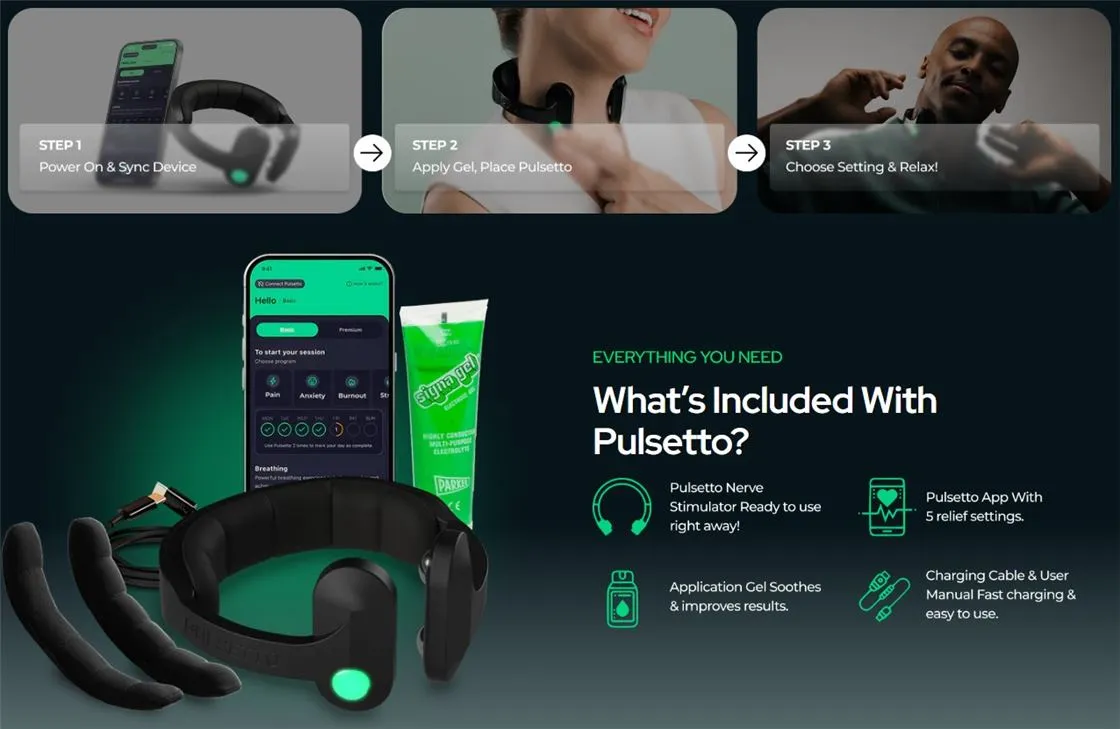
- 10:45pmFour-minute device session, in bedThe anchor of the routine. Put it on, start the sleep programme, lie still. Nothing to count or remember.
- 11:00pmLights outBathroom light kept low on the way.
Total added effort: roughly fifteen minutes, most of which you were going to spend anyway. The four-minute session at the end is what holds the whole sequence together, because it is the only step that does not rely on you remembering to do it properly.
Where structure and devices fit
Here is the real obstacle with everything above: you already knew most of it. Knowledge was never the bottleneck. Doing it every night, when you are tired and would rather scroll, is the bottleneck.
This is where a dedicated device earns its place. Everything on the list so far asks you to remember something, time something or count something at the exact moment your willpower is lowest. A device removes all three. You put it on, press start, and the routine happens whether or not you had the discipline for it that night.
What a vagus nerve device adds to an evening routine
- It makes the habit automatic. A fixed four-minute programme turns "I should wind down" into a specific thing with a start and an end, which is exactly what fails when you rely on intention alone.
- It works hands-free. Neck-worn devices sit in place while you lie down, so you are not holding anything or watching a timer.
- It is drug-free and non-invasive. No pills, nothing to swallow, nothing that interacts with anything else you take.
- It targets the pathway directly. Rather than approaching relaxation indirectly through light or temperature, these devices apply mild stimulation near the nerve involved in the recovery response itself.
- There is a dedicated sleep programme. On Pulsetto the companion app is free and includes a sleep-specific setting alongside stress, anxiety, burnout and pain.
- It gives you something to be consistent with. Users who report the best experiences are almost always the ones who ran short sessions nightly rather than long ones occasionally.
Many users report feeling calmer and falling asleep more easily after regular sessions with vagus nerve devices. Responses vary from person to person and these are sold as wellness products rather than treatments, but for people whose main obstacle is consistency, the structure a device provides is often the piece that was missing.
The other practical advantage is that you can find out cheaply whether it works for you. Pulsetto carries a 30-day money-back guarantee and a two-year hardware warranty, so testing it against your own evenings for a month costs you nothing but the effort of trying.
The device most people in this category ask about
We reviewed Pulsetto in full: how the sleep programme works, what comes in the box, real pricing across the three kits, and how it compares with the alternatives. Backed by a 30-day money-back guarantee.
Read the Pulsetto ReviewWhen this is not the right article
If difficulty sleeping persists for more than a few weeks, affects your functioning during the day, or comes with loud snoring, gasping, or anxiety that interferes with daily life, that is a medical conversation rather than a routine problem. A blog article is not the right tool for it.
Insomnia that has become chronic responds to specific treatment, and sleep apnea will not be solved by dimming your lights. Both are worth a doctor's time. Nothing on this page is a substitute for that.
Common questions
How long before bed should I start winding down?
Most wind-down routines are built around a 30 to 60 minute window. Two elements have their own timing from research: a warm bath works best around 90 minutes before bed, and caffeine needs a far longer runway. Consistency matters more than the exact length of the routine.
Does breathing out longer than you breathe in really calm you down?
Slow breathing itself has solid evidence for increasing parasympathetic activity. The specific claim that a longer exhale beats an even ratio is weaker than commonly stated. One review found nine studies reached four different conclusions, so treat exact ratios as optional rather than essential.
How many hours before bed should I stop drinking coffee?
Caffeine has a half-life of roughly three to six hours, but individual range runs from 1.5 to 9.5 hours. Trial evidence suggests around 100 mg is tolerable four hours before bed, while 400 mg can disrupt sleep architecture even twelve hours ahead.
When should I take a warm bath or shower for better sleep?
A meta-analysis of seventeen studies found warm bathing at roughly 40 to 42.5 degrees Celsius, one to two hours before bed, shortened the time taken to fall asleep by about 36 percent. Around 90 minutes before bedtime appears to be the practical sweet spot.
Does alcohol help you sleep?
It makes falling asleep feel easier and makes the second half of the night measurably worse, which is why waking at three in the morning is such a common pattern after drinking. If your sleep breaks up in the early hours, alcohol is a reasonable first suspect.
When should I see a doctor about sleep problems?
If difficulty sleeping persists for more than a few weeks, affects your functioning during the day, or comes with loud snoring, gasping, or anxiety that interferes with daily life, that is a medical conversation rather than a routine problem. A blog article is not the right tool for it.
Why do I feel wired but tired at night?
That combination usually means your body is exhausted while your nervous system is still in an alert state. Late screens, evening work, caffeine, alcohol and unresolved stress all contribute. A wind-down routine aims to close that gap rather than add more stimulation.
Do vagus nerve devices help with sleep?
Some users report feeling calmer and falling asleep more easily after regular sessions, but responses vary and these are sold as wellness products rather than treatments. They are best understood as a way to give a wind-down routine structure, not as a replacement for sleep habits.
Related reading
If you want the background on why the neck comes up so often in this topic, start with what the vagus nerve actually is. If you have already decided to look at hardware, choosing a device by use case covers why the best pick for sleep differs from the best pick for daytime stress.
And if what wakes you is a stiff neck rather than a busy mind, the cause may be mechanical rather than nervous. How high your pillow holds your head decides the angle your neck keeps for six or seven hours, which is a different problem from the one this article is about. Our six-month review of a contour pillow covers what that shape actually does and what it costs.
Sources
- Laborde S. et al. Effects of voluntary slow breathing on heart rate and heart rate variability: A systematic review and meta-analysis. Neuroscience & Biobehavioral Reviews. PubMed summary
- Do Longer Exhalations Increase HRV During Slow-Paced Breathing? Applied Psychophysiology and Biofeedback, 2024. Springer
- Haghayegh S. et al. Before-bedtime passive body heating by warm shower or bath to improve sleep: A systematic review and meta-analysis. Sleep Medicine Reviews. ScienceDirect
- Dose and timing effects of caffeine on subsequent sleep: a randomized clinical crossover trial. SLEEP, Oxford Academic. Oxford Academic
- Drake C. et al. Caffeine effects on sleep taken 0, 3, or 6 hours before going to bed. Journal of Clinical Sleep Medicine. PubMed