If you have spent any time reading about stress, sleep or recovery lately, you have run into the phrase "vagus nerve". It usually arrives with a promise attached: activate it and you will feel calmer, sleep more deeply, recover faster. What almost never comes with it is a clear explanation of what the thing actually is.
This guide fixes that. No diagrams that need a biology degree, no claims about curing anything. Just what the vagus nerve is, why it matters for how wound up you feel at ten at night, and what the research says about stimulating it deliberately.
It also answers the question most people arrive with once they understand the basics: whether the devices built around this nerve, such as the neck-worn Pulsetto, are doing something real or simply selling a story. The short answer is that the mechanism is measurable, and we will show you the studies.
The short version
- The vagus nerve is the main communication line between your brain and your internal organs.
- It is the backbone of your rest-and-recover mode, the opposite of fight-or-flight.
- Part of it runs close to the surface of your neck, which is why devices like Pulsetto target that exact spot.
- Controlled studies have measured changes in heart rate variability during transcutaneous stimulation compared with sham.
- A four-minute daily session is the practical way most people apply this at home.
The name is a clue
The vagus nerve carries signals between your brain and several organs, including the heart, lungs and digestive tract. It is the main pathway of the parasympathetic system, the side of your nervous system associated with resting, digesting and recovering rather than reacting to threat.
Most nerves have a short, specific job: this one moves that muscle, this one carries sensation from that patch of skin. The vagus nerve is different. It wanders, which is exactly what "vagus" means in Latin. It is the longest of the cranial nerves, running from your brainstem down through the neck, into the chest, and all the way to the abdomen.
That is why it turns up in conversations about heart rate, breathing, digestion and mood all at once. It touches a remarkable number of systems on its way down.
It runs in both directions
Your brain sends signals down it, but a large share of the traffic goes the other way, carrying information from your organs back up. Your gut really does talk to your brain, and this is one of the roads it uses. That two-way design is part of why the nerve became such an interesting target: influence it in one place and the effects are not confined to that place.
Where exactly is it?
It starts in the brainstem, runs down each side of the neck near the carotid artery, and branches out through the chest and abdomen. Because part of it passes close to the surface of the neck, that area is where non-invasive stimulation devices are usually placed.
This anatomical detail is the whole reason a consumer device category exists. If the nerve ran deep through the middle of your torso, there would be no way to reach it without surgery. Because a portion of it passes near the surface of the lower neck, and another branch reaches the outer ear, both spots became accessible targets for stimulation through the skin.
The two spots are not equivalent, though. A 2025 study comparing the cervical branch at the neck with the auricular branch at the ear found the neck carries roughly five to six times more of the specific nerve fibers involved in this kind of signaling, and does so in both directions rather than one [5]. That difference is part of why neck-worn designs, the approach Pulsetto uses, have drawn more research attention than ear-based alternatives.
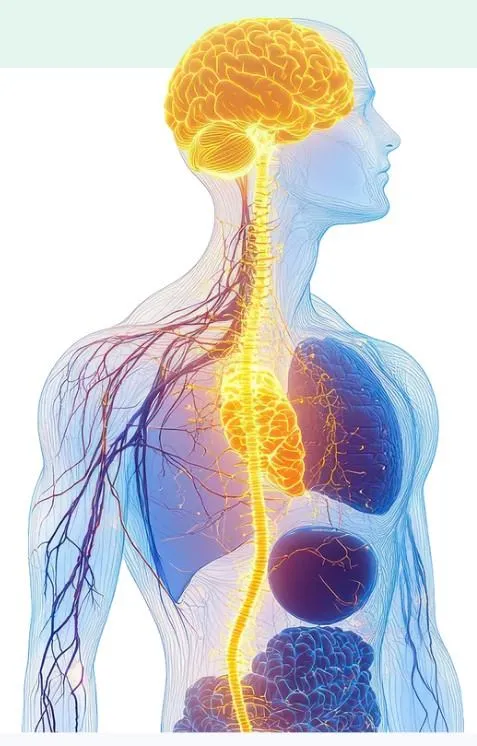
The lower neck is where the nerve runs closest to the surface, which is why devices sit there.
Two modes, one balance point
Your autonomic nervous system, the part that runs without you thinking about it, has two broad settings.
Sympathetic: the accelerator
Heart rate climbs, breathing gets shallow and fast, muscles tense, digestion pauses. It is what happens when a car cuts you off, when your manager schedules a vague meeting, or when you remember an unsent email at eleven at night. Genuinely useful in emergencies. Considerably less useful when it stays switched on all evening.
Parasympathetic: the recovery setting
Heart rate settles, breathing deepens, digestion resumes, the body starts repairing. The vagus nerve is the principal pathway for this side of the system, which is why it gets nicknamed the body's calm switch.
Calling it a switch is a simplification worth being honest about. It is not a light you flip. It is closer to a balance point between two systems that are both always running. The goal is not to shut off the accelerator permanently, it is to be able to come back down after using it.
For a lot of people the problem is precisely that: the coming-down part stopped happening automatically somewhere around their thirties, and nothing in a normal evening actively signals that the day is over.
What vagal tone means, and what it does not
Vagal tone describes how responsive this system appears to be, usually estimated through heart rate variability. Higher measures are generally associated with recovering more easily after stress. It shifts with sleep, alcohol, illness and training, so trends over weeks tell you far more than any single reading.
Heart rate variability, or HRV, is the small variation in time between consecutive heartbeats. Counterintuitively, more variation is generally the better sign: it suggests a system that can adjust rather than one stuck at a fixed rate.
The number is not a score you grind upward
Vagal tone gets marketed as though it were a fitness stat you can level up. In practice it moves with sleep, alcohol, illness, training load, hydration and time of day. A single reading tells you very little. A trend over several weeks tells you more, and even then it is one signal among many rather than a verdict on your health.
What happens when you stimulate it deliberately
This is where the topic moves from anatomy to something you can act on.
Transcutaneous stimulation means applying mild electrical pulses through the skin rather than through an implant. Consumer devices place electrodes on the neck or ear, where the nerve runs close to the surface, and run short sessions of a few minutes at low intensity.
Implanted vagus nerve stimulation has existed in clinical medicine for decades, but it involves surgery. The consumer category is built on the non-invasive version, usually abbreviated as tVNS when applied to the neck or taVNS when applied to the ear.
What the studies have measured
Research on non-invasive stimulation has focused heavily on whether it produces measurable autonomic changes, most often through heart rate variability, and typically compares active stimulation against a sham condition so participants cannot easily tell which they received.
- A randomized crossover trial in healthy adults tested several active stimulation protocols at different frequencies and pulse widths against an inactive sham condition, examining the effects on heart rate variability [1].
- Controlled work has examined cardiac and peripheral autonomic responses during transcutaneous stimulation, including under orthostatic stress [2].
- Further studies have applied machine learning approaches to determine the effects of auricular stimulation on heart rate variability indices [3].
- Randomized designs assigning participants to control, sham and active stimulation groups across pre-stress, stress induction and post-stress phases have reported evidence of a beneficial effect on stress processing [3].
Controlled studies have measured changes in heart rate variability during and after transcutaneous stimulation compared with sham conditions, and randomized trials have examined its effects on stress processing. Results vary by protocol, and consumer devices are sold as wellness products rather than medical treatments.
Two honest caveats. First, protocols in research vary considerably in frequency, pulse width, placement and duration, so results are not perfectly transferable between studies or to any particular consumer product. Second, none of this makes a consumer device a treatment for a diagnosed condition, and manufacturers do not claim that it is.
What it does establish is that the underlying mechanism is a real, measurable thing rather than pure marketing, which is more than can be said for a lot of the wellness category.
The low-tech ways people engage it
Before hardware enters the conversation, these are the approaches that come up most often.
| Method | How it is thought to work | Practical drawback |
|---|---|---|
| Slow breathing | Slowing the breath increases parasympathetic control of the heart, reflected in HRV measures [4] | Requires you to remember and to count, at the moment you are least inclined to |
| Humming or gargling | Engages muscles at the back of the throat, an area the nerve passes near | Not practical in most settings, and effects are poorly quantified |
| Cold water on the face | Triggers a reflex that slows heart rate | Unpleasant, and not something most people sustain nightly |
| Gentle neck movement | Releases physical tension in the surrounding area | Indirect, with modest evidence |
| Device stimulation | Applies mild pulses directly at the point where the nerve is accessible | Upfront cost, though usually with a money-back window |
Notice the pattern in the drawbacks column. Every low-tech method depends on you performing it correctly and consistently, unaided, at the end of a long day. That is the practical reason the device category grew: it removes the part of the equation that human beings are worst at.
Why the device approach became popular
Three things happened at roughly the same time.
Wearables made recovery measurable. Rings and watches started reporting heart rate variability. Once people could see a number, they wanted to influence it.
Chronic low-grade stress became a mainstream concern. Not clinical anxiety necessarily, just the ordinary modern problem of never quite powering down. That created appetite for something that was neither medication nor another meditation app.
The hardware became small and affordable. Stimulating this nerve through the skin used to require clinic equipment. It is now a device you wear on your neck for four minutes.
What a modern device actually gives you
- Direct targeting. Rather than approaching relaxation indirectly through light or temperature, stimulation is applied at the point where the nerve is closest to the surface.
- A session that runs itself. Nothing to count, nothing to remember, nothing to get wrong. You press start and lie still.
- Short enough to repeat nightly. Neck-worn devices such as Pulsetto use roughly four-minute programmes, which is the difference between a routine you keep and one you abandon.
- Drug-free and non-invasive. No pills, nothing to swallow, no interaction with anything else you take.
- Programme presets. Separate settings for sleep and daytime stress rather than one generic mode.
Want to see how this works in practice?
We reviewed Pulsetto, the neck-worn device most people in this category ask about, covering the sleep programme, real pricing, and how it compares with the alternatives. Backed by a 30-day money-back guarantee.
Read the Pulsetto ReviewWho should be careful
People with a pacemaker, implanted electrical or metal devices, epilepsy, heart conditions or carotid artery issues, and those who are pregnant, should not use these devices without medical approval. They are wellness products, not treatments, so speak to a doctor if unsure.
This is not boilerplate. Stimulation near the neck interacts with an area that includes the carotid artery, and anything involving electrical current warrants caution around implanted electronics. If any of the above applies to you, the conversation belongs with a doctor rather than with a product page.
Common questions
What does the vagus nerve actually do?
The vagus nerve carries signals between your brain and several organs, including the heart, lungs and digestive tract. It is the main pathway of the parasympathetic system, the side of your nervous system associated with resting, digesting and recovering rather than reacting to threat.
Where is the vagus nerve located?
It starts in the brainstem, runs down each side of the neck near the carotid artery, and branches out through the chest and abdomen. Because part of it passes close to the surface of the neck, that area is where non-invasive stimulation devices are usually placed.
What is vagal tone and can you improve it?
Vagal tone describes how responsive this system appears to be, usually estimated through heart rate variability. Higher measures are generally associated with recovering more easily after stress. It shifts with sleep, alcohol, illness and training, so trends over weeks tell you far more than any single reading.
What is transcutaneous vagus nerve stimulation?
Transcutaneous stimulation means applying mild electrical pulses through the skin rather than through an implant. Consumer devices place electrodes on the neck or ear, where the nerve runs close to the surface, and run short sessions of a few minutes at low intensity.
Does stimulating the vagus nerve actually do anything measurable?
Controlled studies have measured changes in heart rate variability during and after transcutaneous stimulation compared with sham conditions, and randomized trials have examined its effects on stress processing. Results vary by protocol, and consumer devices are sold as wellness products rather than medical treatments.
How long does a vagus nerve stimulation session take?
Consumer devices typically run sessions of about two to thirty minutes depending on the model. Neck-worn devices such as Pulsetto use roughly four-minute programmes designed to be repeated once or twice daily, which makes them practical to build into an evening routine.
Is vagus nerve stimulation safe for everyone?
No. People with a pacemaker, implanted electrical or metal devices, epilepsy, heart conditions or carotid artery issues, and those who are pregnant, should not use these devices without medical approval. They are wellness products, not treatments, so speak to a doctor if unsure.
Where to go next
If your evenings are the problem, our guide to calming your nervous system before bed puts this into a practical routine with the research behind each step.
If you are already looking at hardware, start with choosing a vagus nerve device by use case, because the right pick for sleep is genuinely different from the right pick for daytime stress.
Sources
- The Acute Effects of Varying Frequency and Pulse Width of Transcutaneous Auricular Vagus Nerve Stimulation on Heart Rate Variability in Healthy Adults: A Randomized Crossover Controlled Trial. PMC
- Cardiac and Peripheral Autonomic Responses to Orthostatic Stress During Transcutaneous Vagus Nerve Stimulation in Healthy Subjects. PMC
- Determination of the Effects of Transcutaneous Auricular Vagus Nerve Stimulation on the Heart Rate Variability Using a Machine Learning Pipeline. PMC
- Laborde S. et al. Effects of voluntary slow breathing on heart rate and heart rate variability: A systematic review and meta-analysis. PubMed
- Comparative afferent and efferent fiber composition of the cervical and auricular branches of the vagus nerve. American Journal of Physiology, 2025. AJP